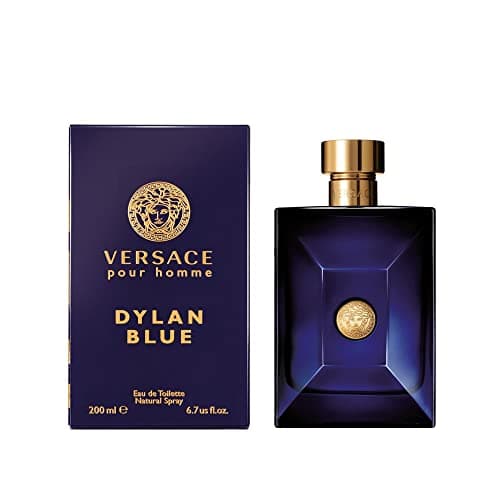
Versace Dylan Blue is what happened when a designer house looked at the crowded "fresh blue fragrance" shelf and decided the way to stand out was to make one that did not smell entirely clean. It opens like an aquatic and finishes like a woody amber, and that split personality is the whole reason it is still in heavy rotation nearly a decade after launch.
It arrived in July 2016, composed by Alberto Morillas — the nose behind a long list of modern fresh benchmarks. If you have ever wondered why so many bottles from 2016 onward smell fresh-but-dark, Dylan Blue is a large part of the answer.
The notes
Versace lists Calabrian bergamot, grapefruit, fig leaf and a water accord up top; violet leaf, papyrus, black pepper, patchouli and ambroxan through the heart; and mineral musk, tonka bean, incense and saffron in the base. On skin that translates to a bright, slightly bitter citrus for the first ten minutes, then a green-peppery middle, and finally a dry, mineral, faintly smoky finish that is much darker than the bottle color suggests.
The fig leaf is the detail worth calling out. Fig leaf smells green and milky rather than fruity, and it is what stops the opening from being another lemon-and-sea-air cliche. The saffron and incense in the base are subtle — you notice them as a texture, a faint rasp under the musk, rather than as identifiable notes. If that vocabulary is new, our guide to fragrance notes unpacks how a note pyramid actually maps onto what you smell.
Performance
Dylan Blue is one of the reasons people stopped assuming EDT means weak. Going by its concentration and the consistent reports on Fragrantica, Basenotes and r/fragrance — not any testing of our own — expect roughly six to eight hours with a strong first two, and a scent trail that fills a room early on. Two sprays is plenty. Four is a decision other people will have opinions about.
That strength is why it behaves differently by season. In cold air it is well-mannered and the woody base does the work. In a hot, closed room the ambroxan can turn sharp. Our guide to sillage and projection explains why the same two sprays behave so differently in July and January.
Who it's for, who should skip it
Buy it if you want one bottle that covers a workday, a dinner and a weekend without thinking about it, and if you like fresh scents but find most of them thin. It is also a sensible first designer bottle because it is discounted almost permanently — the list price and the price you actually pay are rarely the same number.
Skip it if being recognizable matters to you. Dylan Blue sold in enormous volume and you will meet it on other people, in lifts and at parties. Skip it too if ambroxan-forward bases give you that scratchy, synthetic impression — that material is load-bearing here, not a garnish.
Dylan Blue vs the obvious alternatives
Against Versace Eros, its own stablemate, Dylan Blue is the daytime option: Eros is sweet mint and vanilla built for a night out, while Dylan Blue is dry and green and will not embarrass you at 9am. Against Dior Sauvageit is less peppery, with more of a green bitterness in the opening and a slightly smaller crowd wearing it — our Dylan Blue vs Sauvage comparison settles that matchup situation by situation. And against a budget aquatic like Nautica Voyage, the honest comparison is that Voyage smells good for an hour or two and Dylan Blue smells good for most of a day — you are paying for the back half.
Is it worth it?
Yes, with one condition: buy it because you like the dry, woody drydown, not because you want a clean citrus. People who buy Dylan Blue expecting a simple summer scent are often surprised by how dark it gets after an hour. People who buy it for that darkness tend to keep repurchasing. It sits comfortably in our best summer colognes ranking and turns up again on the best cologne for men shortlist for exactly that reason.
Two head-to-heads are worth reading if you are still deciding. Against its own stablemate, where the deciding factor turns out to be dose discipline rather than scent preference: Eros vs Dylan Blue. And against the fresh-aquatic reference by the same perfumer, twenty years earlier: Acqua di Gio vs Dylan Blue.