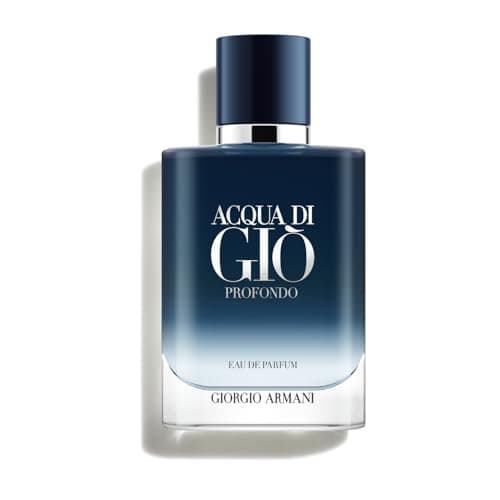
Acqua di Gio Profondo is what happens when the most-worn fresh fragrance in the world grows up, puts on a coat and stops trying to be liked by everyone. Where the original Acqua di Gio is bright citrus over a sea breeze, Profondo is wet rock, cold air, dry herbs and something faintly bitter underneath. It is a better fragrance. It is also about twice the price, considerably less versatile, and sold under a name that now covers at least four different things.
Short version: buy it if you want a fresh fragrance that works in December, in a suit, and in a room full of adults. Skip it if what you actually loved about Acqua di Gio was the lemon-and-sunshine opening, because that is the part Profondo deliberately removes.
Before anything else: make sure you are buying the right bottle
This is the most useful thing we can tell you about this fragrance, and almost no review leads with it. “Profondo” is not one product. Armani has released it as an eau de toilette, an eau de parfum and a Parfum, plus a brighter limited edition called Profondo Lights. Separately, and confusingly, the same line contains Acqua di Gio Profumo— a different, older, smokier fragrance whose name differs from Profondo by three letters. Live Google autocomplete for “acqua di gio profondo” is dominated by exactly this confusion: profondo vs profumo, profondo edp, profondo edt, profondo edp vs parfum, profondo lights.
We will be straight about the limits of what can be verified here. Retailer and fragrance-database listings openly disagree on the launch years of the various Profondo releases — one major database dates an eau de parfum entry to 2024 while retailer copy dates the original Profondo to 2020 — so we are not going to print a date we cannot stand behind. What is not in dispute is how to tell what is in your cart, and that is the part that actually costs you money:
- Check the concentration on the box, not the name. The word Profondo tells you nothing about strength. EDT, EDP and Parfum are three different products at three different prices, and the EDP is the version this review covers and the version most people mean.
- Profondo is not Profumo.Profumo is the darker, incense-and- patchouli entry in the line, described consistently in comparisons as smoky and heavier. If you read a glowing review of “the dark Acqua di Gio,” check which of the two it was about.
- Profondo Lights is a flanker, not the main line. Listings describe it as a brighter, fresher, more citrus-forward limited edition. It is a different fragrance.
- The current EDP bottle is refillable.Armani's own listing says so, and it is a genuine reason to buy the full size rather than replacing bottles.
If the version question is settled and the real decision is whether this is worth its premium over a cheaper bottle doing a similar job, the head-to-head we would point you at is Profondo vs Versace Dylan Blue. Profondo wins the scent column there and still loses the page, which is the clearest illustration of what the 6 in its value row actually means.
The notes
The published pyramid runs green mandarin, bergamot, aquozone and sea notes up top; mastic absolute, cypress, lavender and rosemary through the heart; and patchouli, amber, mineral notes and musk in the base. Armani's own retail listing sells it in shorthand as marine notes, cypress and musk — a citrusy, earthy, woody fresh scent — which is an unusually honest summary for marketing copy.
What that does in the wearing is a three-stage trip away from the family it is named after. The opening is recognizably Acqua di Gio: citrus and that salty synthetic sea accord the line made famous. Within fifteen minutes the mastic and cypress arrive, and this is where Profondo earns its name — mastic is a resinous Mediterranean shrub material, dry and slightly bitter, and cypress is the driest of the common woods. Together they strip the sweetness out and put something almost stony in its place. The base is where the mineral note and the musk take over, and the final hours sit close to the skin as clean, dry, faintly salty warmth. That musk is a synthetic, as it is in every bottle on the market — we explain why that matters, and rank the bottles where musk is the subject rather than the polish, in best musk colognes.
The honest description of the overall effect is wet stone. If that sounds appealing, this is a very good fragrance. If it sounds like a strange thing to pay three figures for, that reaction is also reasonable, and the best fresh colognes roundup has cheaper bottles pointed at the brighter end of the same idea.
Performance
We have not lab-tested this, and we will not pretend otherwise — our read is compiled from Armani's stated concentration plus what wearers consistently report. By that measure the eau de parfum concentration does exactly what it should: this projects properly for the first two to three hours and stays detectable most of a working day, which puts it well clear of the original Acqua di Gio EDT, whose modest longevity is the most common complaint in its own review on this site. Three sprays is plenty. Four in a small room is too many.
Where it genuinely outperforms its family is in cold air. Most aquatics thin out and vanish below about fifty degrees; the resin and wood in Profondo's heart give it enough body to survive a winter commute, which is why we would pick it over the original for any formal evening between October and March. In July it is competent but unnecessary — the cheaper, brighter bottles in best summer colognes do that job as well for a third of the money.
Is it worth it?
Here is the value question put plainly, because this is the most expensive fragrance we have reviewed in the fresh category. Profondo costs in the region of twice the current street price of the Acqua di Gio EDT. For that you get a genuinely more interesting composition, a real concentration upgrade, and a bottle you can refill. You do not get twice the fragrance, and you lose some versatility on the way — the original is the safer choice for a single do-everything bottle, and we have said so consistently.
So the recommendation splits by situation rather than by budget. If this would be your only fresh fragrance, buy the original EDT and spend the difference on a second bottle in a different family. If you already own a bright aquatic and you want the cold-weather, formal, grown-up version of that idea, Profondo is the correct purchase and there is no cheap bottle that does the same thing — the dry mineral-herbal structure is the part the clone houses have not convincingly copied. Our honest cost-per-wear framework for decisions like this is in how much should you spend on cologne.
Who should buy it
Buy Profondo if you want a fresh fragrance with weight, you wear a lot of tailoring, you live somewhere with a real winter, or you have worn the original Acqua di Gio for years and want the same world rendered darker. It is also an unusually good choice for formal events where a sweet or smoky fragrance would be wrong — see best colognes for a wedding.
Do not buy it if you want the beach-and-lemon original, if you need one bottle to cover everything, if mineral or bitter notes put you off, or if the price is a stretch — this is a second or third bottle, not a first one. And if you have never smelled it, do not blind-buy at this price. A single decant or sample costs a few dollars and the mineral edge here is divisive enough to make that the single best-value purchase on this page.