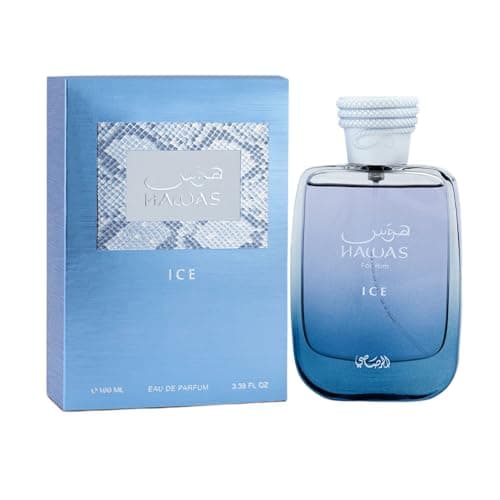
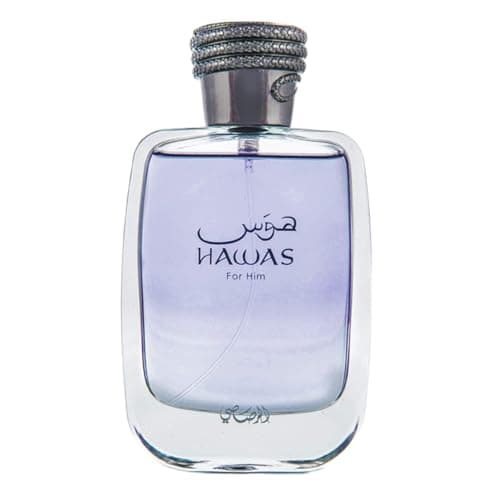
Buy the original Rasasi Hawas if you want the bottle that earned the reputation: apple and cinnamon over a salty, woody drydown, the best performance-per-dollar on this site, and the one people actually get complimented on. Buy Hawas Ice if you live somewhere hot, if cinnamon on skin is not for you, or if you already own the original and want the same shape in a cooler register.
Most flanker comparisons are tedious because the flanker is usually the original with the interesting part removed. This one is worth writing because the published pyramids tell a much more specific story: Hawas and Hawas Ice share an identical heart, note for note. The difference is two deliberate swaps, one at the top and one at the bottom, and once you see them the choice stops being guesswork.
The two pyramids, side by side
| Rasasi Hawas (original) | Rasasi Hawas Ice |
|---|
| Launched | 2015 | 2023 |
| Concentration | Eau de parfum | Eau de parfum |
| Top | Bergamot, apple, cinnamon, lemon | Apple, Italian lemon, Sicilian bergamot, star anise |
| Heart | Watery notes, plum, orange blossom, cardamom | Plum, orange blossom, cardamom |
| Base | Ambergris, musk, driftwood, patchouli | Musk, amber, driftwood, moss |
| The decisive material | Cinnamon — warmth inside a fresh fragrance | Star anise — cool-sweet licorice in its place |
| Our score | 8.8 | 8.2 |
Read the heart row again. Plum, orange blossom and cardamom in both, in the same order — this is not a coincidence or a marketing accident, it is the same middle. The original adds watery notes to it; Ice does not list them, which is mildly ironic and almost certainly a copywriting artifact rather than a formulation difference you could pick out.
The swap that decides it: cinnamon out, star anise in
Cinnamon is the original's signature and its risk.It is an odd thing to find in a fresh fruity fragrance, and it is exactly why Hawas does not smell like the other apple-and-bergamot bottles in its price bracket. It gives the opening a dry, warm, faintly bakery-adjacent edge that pulls the whole composition toward the cold-weather end of the year. People who love Hawas usually love that warmth without naming it. People who find Hawas “heavy for a fresh scent” are reacting to the same note.
Star anise does the opposite job in the same slot.Anise is cool-sweet and licorice-like, and it reads as crisp rather than warm. Swap it in for cinnamon and the fruit stays, the plum-and-cardamom heart stays, and the temperature of the whole fragrance drops. That is the honest meaning of the word “Ice” on this bottle: not mint, not a menthol blast, not a different fragrance — the same fragrance with its warmth removed and something crisp put in its place.
The base swap reinforces it. The original lists ambergris and patchouli, both of which read dense and slightly animal; Ice lists amber and moss instead, which are drier and greener. Our what does ambergris smell like guide covers why that one material has such an outsized effect on how expensive a drydown reads, and fragrance notes explained covers how to read a pyramid like the table above without over-trusting it.
One sourcing caveat we will state rather than hide: retailer listings for Hawas Ice are not perfectly consistent. The pyramid above is the version that appears across multiple independent retailers, and we are using it because it is corroborated, not because any single store is authoritative. A couple of listings substitute jasmine and violet in the heart or cedarwood in the base. We think those are copy errors; we cannot prove it, so we are telling you they exist.
Performance: closer than the scores suggest
We have not lab-tested either bottle and will not pretend we did — the read below is compiled from the stated concentration plus what wearers consistently report, scored against our published rubric.
Both are eau de parfums from a Dubai house that does not water things down, and both perform far above their price bracket. The original is the stronger of the two by a small margin: reported wear times are commonly eight to ten hours with heavy projection through the first three. Ice is close but reads slightly lighter, which is what you would expect when you take out the cinnamon and the ambergris and put in anise and moss — cool, dry materials tend to sit nearer the skin than warm, resinous ones.
The practical note that applies to both: you need fewer sprays than you think. Two is a normal dose from either bottle and four is a statement. If you have been applying five sprays of a weak designer eau de toilette out of habit, recalibrate before you leave the house. Our guide to applying cologne covers placement, and sillage and projection explained separates the two things people mean when they say a bottle is strong.
Price, and why value is not the tiebreaker here
Unusually for a comparison, price does not decide this one. Both bottles are 3.4 oz eau de parfums from the same house and they sit in the same budget bracket — the original scores a 10 for value on our rubric and Ice a 9, and the gap reflects the original's slightly better performance rather than a meaningful difference at the till. Whatever the live numbers say on the day you read this, you are not choosing between a cheap bottle and an expensive one.
The live, date-stamped price for each is in the cards below, pulled from the retailer rather than typed by us. We mention it only so you can check that neither has drifted: when two bottles are this close on quality, a temporary discount on one is a perfectly good reason to buy that one.
A warning about the rest of the family
Hawas has grown into a large line — Ice, Fire, Black, Kobra, Malibu and more. These are flankers, not reformulations: different fragrances sharing a name, and they do not all perform the way the original does. If someone recommends “Hawas” with no qualifier, they mean the original blue bottle. If you are buying on a recommendation, confirm which one was meant before you order, because the bottles look related and the contents are not interchangeable.
The other persistent confusion worth clearing up: the original is almost always introduced as “the cheap Creed Aventus,” and it is not one. Aventus is a smoky chypre built on pineapple, birch tar and oakmoss; Hawas is a sweet aquatic built on apple and driftwood. They occupy adjacent territory and smell clearly different side by side. The bottles that genuinely do target Aventus are ranked in our best Creed Aventus clones, and the full argument is in the Rasasi Hawas review.
Where each one is the obvious answer
The original wins: cooler weather, evenings, dates, and any situation where you want the compliment record rather than the safe choice. It is also the right first Hawas, because the cinnamon is the reason the line exists and you should know whether you like it before you buy a version that removes it. See best colognes under $50 and longest-lasting colognes.
Ice wins: real summer heat, humid climates, offices where sweetness carries badly, and the specific case where you tried the original and found the cinnamon too warm on your skin. It is also the better second bottle if you already own the original, since buying a near-identical warm fruity aquatic twice is a waste of money. See best summer colognes and best fresh colognes.
Neither winsif sweet fruit is simply not your register. Both bottles are built on apple and plum and neither hides it. If that profile is wrong for you, the whole Hawas family is the wrong aisle and a dry citrus-and-woods fragrance is what you actually want — Profondo vs Dylan Blue covers two good options at that end, and Bleu de Chanel is the expensive answer to the same brief.